
AR Muzzle Device Design and Selection Guide
TL;DR: Article Summary
Muzzle devices are gas-control tools. Their geometry determines how propellant gases are redirected, contained, or released, which in turn affects recoil, muzzle rise, flash, blast, sound, and suppressor compatibility. Device selection is not about finding a universally “best” option — it is about choosing the right tradeoffs for the rifle’s intended role. Brakes prioritize recoil reduction, compensators prioritize muzzle-rise control, flash hiders prioritize signature reduction, blast-forwarding devices prioritize shooter comfort, and suppressors prioritize sound, flash, and blast reduction while introducing added length, weight, and backpressure. Materials, finishes, mounting method, and alignment all matter, especially on suppressor hosts.
Introduction – Not Just a Pretty Face
Muzzle devices are often treated like accessories, but they are functional gas-management components that can materially change how a rifle behaves. The difference between an open-tine flash hider, an aggressive brake, a compact compensator, and a suppressor-ready muzzle device is not cosmetic — it is geometric. Port direction, chamber volume, baffle angle, exit geometry, and bore clearance all affect what the device does and what it costs you elsewhere.
What is the Muzzle Device and Why Does It Matter?
A muzzle device is the component attached to the end of the barrel to manage how gases leave the muzzle after the bullet exits. Depending on its geometry, a muzzle device can reduce recoil, counteract muzzle rise, suppress visible flash, redirect blast away from the shooter, provide a suppressor mounting interface, or combine several of those functions. It also affects installation, alignment, suppressor compatibility, and in some builds, legal barrel length.
Core Functions of the Muzzle Device
1. Gas Redirection
Muzzle devices redirect expanding gases as they leave the muzzle. By changing the direction of gas flow — upward, laterally, rearward, forward, or some combination — the device changes how force is applied to the rifle and how blast is distributed around the shooter.
2. Gas Expansion and Containment
Some muzzle devices provide internal volume for gas to expand, slow, or be staged before release. This changes pressure behavior at the muzzle and can be used to reduce blast severity, alter impulse shape, suppress flash, or reduce sound in more enclosed designs.
3. Gas Dispersion
Muzzle devices can also disperse gas more broadly or more evenly as it exits. This is especially important for reducing visible flash, softening directional blast, or preventing one control effect from becoming too concentrated in a single direction.
4. Mounting and Interface
Many muzzle devices also serve as mechanical interfaces rather than purely gas-control components. They may provide suppressor-mount geometry, require specific timing features, or become part of a permanently attached barrel assembly. In these cases, alignment, retention, and compatibility are just as important as gas behavior.
🔵 Design & Construction

Muzzle device construction is simple in concept but critical in execution. Every design begins with the same basic architectural questions: what carries the loads, what controls the gas, how the device mounts to the barrel, whether it must be timed, and whether it must also serve as a suppressor interface. The details vary by device type, but the same core construction elements appear again and again.
Hardness: 26-34 HRC
Finish: MIL-STD-171 5.3.1.2 (Class 1 Manganese Phosphate)
🔹 Muzzle Device Body
Overview:
The muzzle device body is the primary structural component of the assembly. It contains the internal geometry of the device and provides the threaded interface to the barrel. Regardless of device type, the body defines the overall envelope, supports the functional features, and carries installation and firing loads.
Function:
The body mounts the device to the barrel, contains and supports the gas-management features, and provides the structure required for repeated exposure to heat, pressure, installation torque, recoil loads, and fouling. It also establishes the external dimensions and internal volume available for ports, baffles, chambers, tines, or suppressor-mount features.
🔹 Ports, Baffles, and Expansion Chambers
Overview:
Ports, baffles, and expansion chambers are the internal gas-management elements of a muzzle device. Their geometry varies by device type, but together they define how the device captures, redirects, and releases gas.
Function:
Ports provide exit paths for gas, baffles create internal surfaces that interrupt and redirect flow, and expansion chambers provide internal volume for gas to expand before release. These elements form the core internal architecture of most active muzzle devices.
🔹 Mounting Interface
Overview:
The mounting interface is the portion of the muzzle device that attaches to the barrel. This typically consists of the threaded bore, rear shoulder engagement surface, and any geometry used to seat, time, or secure the device during installation.
Function:
The mounting interface aligns and retains the muzzle device on the barrel while resisting installation torque, recoil forces, and thermal cycling. It establishes concentricity with the bore, provides the surface relationship needed for proper seating, and determines compatibility with shims, crush washers, lock nuts, taper mounts, or suppressor-mount systems.
🔹 Timing Features
Overview:
Timing features allow a muzzle device to be installed in a specific rotational orientation when the design requires indexed alignment.
Function:
They provide the reference surfaces or interfaces needed to achieve correct final orientation during installation, especially on devices whose geometry must face a specific direction.
🔹 Suppressor Mount Features
Overview:
Suppressor mount features are the attachment elements incorporated into a muzzle device to interface with a compatible suppressor. These may include external lugs, locking grooves, taper surfaces, secondary retention geometry, or other proprietary mounting features built into the device body.
Function:
These features provide the mechanical interface that allows the suppressor to attach securely and align concentrically with the bore. They establish compatibility with a given suppressor mounting system, support repeatable installation and removal, and help maintain retention under heat, fouling, and recoil.
🗝️ Key Takeaways
- The body provides the structure, envelope, and threaded connection to the barrel
- Ports, baffles, and chambers form the internal gas-management architecture
- The mounting interface controls alignment, seating, and retention on the barrel
- Timing features matter when the device must be clocked to a specific orientation
- Suppressor-mount features add another layer of interface, retention, and concentricity requirements
🔵 Materials
Muzzle device material selection primarily affects durability, heat resistance, gas erosion resistance, corrosion behavior, and weight. It does not usually change the basic gas-control strategy of the device — port geometry, baffle design, chamber volume, and bore clearance do that — but it does determine how well the device survives heat, pressure, fouling, erosion, suppressor use, and long-term exposure.
For most AR muzzle devices, material choice falls into a few practical categories. 4140 and 4150 chrome-moly steels are common, affordable, and durable enough for general use, but they require a protective finish for corrosion resistance. 17-4 PH stainless is often the best all-around premium choice because it combines strength, corrosion resistance, heat tolerance, and good durability in hard-use or suppressor-mount applications. 416 stainless is easier to machine and works well in moderate-use devices, but it is less ideal where maximum strength and heat resistance matter. Titanium is useful when reducing front-end weight is the priority, while Inconel and similar nickel alloys are reserved for high-heat, high-erosion, or advanced additively manufactured designs.
| Muzzle Device Material Comparison | ||||
|---|---|---|---|---|
| Material | Weight1 | Durability2 | Thermal Stability3 | Corrosion Resistance |
| Material4140 Chrome-Moly Steel | Weight1Moderate | Durability2Moderate | Thermal Stability3High | Corrosion ResistanceLow |
| Material4150 Chrome-Moly Steel | Weight1Moderate | Durability2Moderate–High | Thermal Stability3High | Corrosion ResistanceLow |
| Material17-4 PH Stainless Steel | Weight1Moderate | Durability2Very High | Thermal Stability3Very High | Corrosion ResistanceHigh |
| Material416 Stainless Steel | Weight1Moderate | Durability2Moderate | Thermal Stability3Very High | Corrosion ResistanceModerate |
| MaterialTi-6Al-4V Grade 5 | Weight1Very Low | Durability2High | Thermal Stability3Very High | Corrosion ResistanceVery High |
| MaterialInconel 718 (AM) | Weight1High | Durability2Very High | Thermal Stability3Moderate | Corrosion ResistanceHigh |

|
||||
Footnotes:
- Based on alloy density
- Based on yield strength, ultimate tensile strength, hardness, and elongation at break for the appropriate condition of each alloy
- Based on linear coefficient of thermal expansion
🗝️ Key Takeaways
- Material choice affects service life, corrosion resistance, heat tolerance, erosion resistance, and weight.
- Geometry controls what the device does; material controls how well it survives doing it.
- 4140 and 4150 are practical baseline steels for general-purpose muzzle devices.
- 17-4 PH stainless is the best all-around premium material for most hard-use muzzle devices and suppressor mounts.
- 416 stainless is useful for moderate-use devices where machinability and corrosion resistance matter more than maximum durability.
- Titanium is best reserved for lightweight builds where reduced muzzle-end weight matters more than maximum heat and erosion resistance.
- Inconel and similar nickel alloys make the most sense in high-heat, high-erosion, or 3D-printed designs where the material and manufacturing method work together.
Need More?
This section summarizes the practical selection guidance. For a more detailed explanation of muzzle device steels, stainless alloys, titanium, Inconel, heat resistance, erosion behavior, and additive manufacturing, see our PBU deep dive.
Continue to Muzzle Device Material Deep Dive🔵 Surface Treatments & Finishes
Muzzle device finishes primarily affect corrosion resistance, surface durability, oxidation resistance, and maintenance requirements. They do not meaningfully change the device’s basic gas-control behavior — port geometry, baffle design, chamber volume, and bore clearance do that — but they do affect how the device holds up to heat, fouling, weather, handling, and repeated cleaning.
For most steel muzzle devices, salt bath nitride offers the best all-around balance of corrosion resistance, surface hardness, wear resistance, and dimensional stability. Manganese phosphate remains simple, inexpensive, and proven, but it relies heavily on oil retention for corrosion protection. DLC provides excellent hardness and wear resistance, but is less ideal for sustained high-temperature service. Cerakote is useful for environmental protection and color matching, but it can degrade under extreme muzzle heat. Passivation is common on stainless parts and improves corrosion resistance without changing dimensions, but its performance depends on the underlying alloy.
| Muzzle Device Finish Comparison | ||||
|---|---|---|---|---|
| Finish | Durability | Corrosion Resistance | Heat Tolerance | Dimensional Impact |
| FinishManganese Phosphate | DurabilityLow | Corrosion ResistanceLow | Heat ToleranceModerate | Dimensional ImpactModerate |
| FinishSalt Bath Nitride (QPQ) | DurabilityVery High | Corrosion ResistanceHigh | Heat ToleranceVery High | Dimensional ImpactNone |
| FinishDLC | DurabilityHigh | Corrosion ResistanceModerate | Heat ToleranceHigh | Dimensional ImpactMinimal |
| FinishCerakote | DurabilityModerate | Corrosion ResistanceVery High | Heat ToleranceModerate | Dimensional ImpactHigh |
| FinishPassivation | DurabilityMaterial-Dependent | Corrosion ResistanceMaterial-Dependent | Heat ToleranceMaterial-Dependent | Dimensional ImpactNone |
|
|
||||
🗝️ Key Takeaways
- Finishes mainly affect corrosion resistance, surface durability, oxidation resistance, and maintenance.
- Finish choice does not replace good material selection or sound device geometry.
- Nitride is usually the best all-around finish for most steel muzzle devices.
- Phosphate is simple and proven, but offers limited corrosion protection without lubrication.
- DLC provides excellent hardness and wear resistance, but has thermal limitations compared with diffusion-based treatments.
- Cerakote is useful for environmental protection and appearance, but is not ideal for sustained high-heat use.
- Passivation improves stainless corrosion resistance without adding thickness, but depends on the base alloy.
Need More?
This section summarizes the practical selection guidance. For a more detailed explanation of muzzle device finishes, coating processes, heat tolerance, corrosion behavior, dimensional effects, and maintenance tradeoffs, see our PBU deep dive.
Continue to Muzzle Device Finishes Deep Dive🔵 Gas Control Strategies & Design Features
Muzzle devices work by controlling how propellant gases leave the muzzle. The device category — flash hider, compensator, brake, blast-forwarding device, suppressor, or hybrid — is really just the categorical label resulting from two things: the gas-control strategy and the geometry used to create it.
The important question is not just what type of device is this? The better question is: what is the device trying to do, how does the geometry create that effect, and what tradeoff comes with it?
A muzzle device can redirect gas rearward to reduce recoil, vent gas upward to counter muzzle rise, disperse gas to reduce flash, channel gas forward to reduce side blast, or contain and slow gas to reduce sound and pressure. Each strategy improves one behavior by sacrificing another. More recoil control usually means more blast. More flash suppression usually means less braking effect. More containment usually means more size, weight, heat, and system influence.
🔹 Recoil Reduction (Rearward Gas Redirection)
Mechanism:
Redirecting gas laterally and rearward creates forward thrust that counteracts the rifle’s rearward motion.
Typical Features:
Rearward-angled ports, tight baffles/bore clearance, larger ports, and multi-chamber layouts.
Primary Effect:
Reduces felt recoil and helps the rifle stay flatter under recoil impulse.
Tradeoff:
Increases side blast, rearward concussion, and noise.
🔹 Muzzle Rise Control (Upward Gas Redirection)
Mechanism:
Venting gas upward generates downward force at the muzzle, opposing climb during firing.
Typical Features:
Top ports, upward-angled vents, top-biased port layouts, and tunable compensation ports.
Primary Effect:
Reduces muzzle rise and improves shot-to-shot recovery in rapid fire.
Tradeoff:
Provides less recoil reduction than a dedicated brake and may increase flash or blast signature.
🔹 Flash Suppression (Gas Cooling & Dispersion)
Mechanism:
Dispersing and cooling gases reduces the likelihood of secondary ignition outside the muzzle.
Typical Features:
Open tines, longitudinal slots, open-front geometry, and symmetric gas dispersion.
Primary Effect:
Reduces visible muzzle flash, especially in low-light conditions.
Tradeoff:
Provides little to no recoil reduction or muzzle-rise control.
🔹 Blast Redirection (Forward Gas Channeling)
Mechanism:
Capturing muzzle gases and directing them forward reduces lateral pressure exposure around the shooter.
Typical Features:
Closed sides, enclosed outer bodies, forward exits, and larger internal volume.
Primary Effect:
Improves shooter and bystander comfort by reducing side concussion.
Tradeoff:
Does not meaningfully reduce recoil or muzzle rise and may increase backpressure.
🔹 Sound Reduction (Gas Containment)
Mechanism:
Containing and slowing expanding gases lowers pressure, temperature, and exit intensity before release.
Typical Features:
Enclosed body, internal baffles, large expansion volume, tight bore alignment, and controlled gas pathways.
Primary Effect:
Reduces sound signature, flash, and blast severity.
Tradeoff:
Adds length and weight and typically increases system backpressure.
🗝️ Key Takeaways
- Muzzle device behavior is defined by gas-control strategy and geometry.
- Device labels are useful, but port direction, baffling, bore clearance, chamber volume, and symmetry determine how the device actually behaves.
- Every useful gas-control strategy creates a tradeoff in blast, flash, sound, backpressure, weight, length, or alignment sensitivity.
Need More?
This section summarizes the practical selection guidance. For a more detailed explanation of how muzzle devices work, including control strategies and features, see our PBU deep dive.
Continue to How Muzzle Devices Work Deep Dive🔵 Device Types
Device categories are best understood as recurring implementations of the strategies and features discussed above. These labels are useful, but they are not rigid engineering boundaries. Many real products combine traits from multiple categories, and the exact behavior always depends on the underlying geometry.
🔹 Bare Muzzle


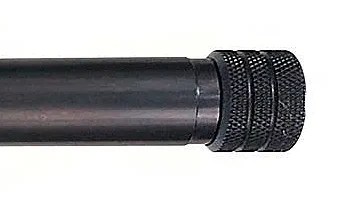

Overview:
A bare muzzle has no muzzle device installed. This may be an unthreaded barrel, a threaded barrel with exposed threads, or a threaded barrel fitted only with a thread protector.
Primary Strategies:
- None
Common Features:
- No ports or baffles
- No expansion chambers
- No gas redirection features
- No blast-forwarding or flash-suppressing geometry
Resulting Behavior:
- No recoil reduction
- No muzzle-rise control
- No flash suppression
- Omnidirectional blast and flash
🔹 Flash Hider


Overview:
A flash hider is designed primarily to reduce visible muzzle flash by dispersing and cooling gases as they leave the muzzle.
Primary Strategies:
- Flash Suppression
Common Features:
- Open-front or open-tine exit geometry
- Symmetrical or near-symmetrical gas release
- Minimal chambering relative to brakes and many hybrids
- Little or no rearward gas redirection
Resulting Behavior:
- Strong flash reduction
- Little to no recoil reduction
- Minimal muzzle-rise control
- Diffuse blast signature
🔹 Compensator
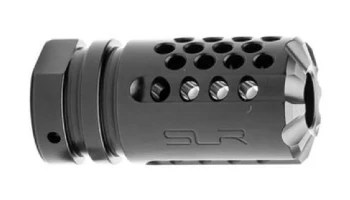


Overview:
A compensator is designed primarily to reduce muzzle rise by venting gas upward or at controlled upward angles.
Primary Strategies:
- Muzzle Rise Control
Common Features:
- Top ports or angled upward vents
- Often asymmetrical or tunable porting
- Limited rearward gas redirection
- Usually less aggressive chambering than a brake
Resulting Behavior:
- Reduced muzzle climb
- Improved shot-to-shot tracking
- Limited recoil reduction
- Increased flash or blast relative to a flash hider
🔹 Muzzle Brake


Overview:
A muzzle brake is designed primarily to reduce felt recoil by redirecting gas laterally and rearward.
Primary Strategies:
- Recoil Reduction
Common Features:
- Side ports or baffles
- Rearward-angled gas surfaces
- Multi-chamber layouts are common
- Larger, more aggressive venting than flash hiders or comps
Resulting Behavior:
- Strong recoil reduction
- Moderate muzzle-rise control, depending on layout
- Increased side blast and concussion
- Little to no flash suppression
🔹 Hybrid Device


Overview:
A hybrid device combines features from multiple device categories to balance recoil reduction, muzzle-rise control, and flash suppression.
Primary Strategies:
- Recoil Reduction
- Muzzle Rise Control
- Flash Suppression
Common Features:
- Mixed port orientation
- Combined brake and compensator geometry
- Flash-hider style front geometry in some designs
- Feature balance depends heavily on intended role
Resulting Behavior:
- Moderate performance across multiple areas
- More balanced behavior than a dedicated brake or comp
- Less optimization in any single control strategy
- Exact tradeoffs depend strongly on geometry and tuning
🔹 Blast-Forwarding Device


Overview:
A blast-forwarding device redirects muzzle blast away from the shooter and nearby personnel rather than reducing recoil or flash directly.
Primary Strategies:
- Blast Redirection
Common Features:
- Enclosed outer body
- Forward exit path
- Little or no lateral venting
- In some cases mounts over an existing brake or compensator
Resulting Behavior:
- Reduced side concussion
- Improved shooter and bystander comfort
- Little to no recoil reduction
- Little to no muzzle-rise control
- Possible increase in backpressure
🔹 Sound Suppressor


Overview:
A sound suppressor reduces sound, flash, and blast by containing and slowing expanding gases before they exit the muzzle.
Primary Strategies:
- Sound and Pressure Reduction
- Flash Suppression
Common Features:
- Internal baffles or monolithic core geometry
- Significant internal volume
- Enclosed gas path
- Tight mounting and bore-alignment requirements
Resulting Behavior:
- Significant sound reduction
- Strong flash reduction
- Reduced blast severity
- Softer recoil impulse
- Increased backpressure
- Added length and weight
The diagram below compares the general gas-flow behavior of the major muzzle device categories side by side.

| Muzzle Device Comparison Summary | ||||||
|---|---|---|---|---|---|---|
| Device Type | Recoil Reduction | Muzzle Rise Control | Flash Suppression | Blast Direction | Suppressor Mount Compatible | Ideal Use |
| Device TypeBare Muzzle | Recoil ReductionNo | Muzzle Rise ControlNo | Flash SuppressionNo | Blast DirectionOmnidirectional | Suppressor Mount CompatibleNo | Ideal UseCompliance, testing |
| Device TypeFlash Hider | Recoil ReductionNo | Muzzle Rise ControlMinimal | Flash SuppressionYes | Blast DirectionDiffuse / Omnidirectional | Suppressor Mount CompatibleSometimes | Ideal UseNight ops, clone builds |
| Device TypeCompensator | Recoil ReductionMinimal | Muzzle Rise ControlYes | Flash SuppressionNo | Blast DirectionUpward / Angled | Suppressor Mount CompatibleRarely | Ideal UseCompetition, fast follow-up |
| Device TypeMuzzle Brake | Recoil ReductionYes | Muzzle Rise ControlMinimal | Flash SuppressionNo | Blast DirectionLateral / Rearward | Suppressor Mount CompatibleSometimes | Ideal UsePrecision, recoil-sensitive shooters |
| Device TypeHybrid Device | Recoil ReductionModerate | Muzzle Rise ControlModerate | Flash SuppressionModerate | Blast DirectionMulti-directional | Suppressor Mount CompatibleOften | Ideal UseDuty, suppressor-ready builds |
| Device TypeBlast-Forwarding Device | Recoil ReductionNo | Muzzle Rise ControlNo | Flash SuppressionNo | Blast DirectionForward Only | Suppressor Mount CompatibleNo | Ideal UseSBRs, team or indoor use |
| Device TypeSuppressor | Recoil ReductionModerate | Muzzle Rise ControlModerate | Flash SuppressionYes | Blast DirectionForward, Internalized | Suppressor Mount CompatibleYes | Ideal UseHearing protection, tactical, hunting |
|
|
||||||
🗝️ Key Takeaways
- Flash hiders prioritize signature reduction
- Compensators prioritize muzzle-rise control
- Brakes prioritize recoil reduction
- Hybrid devices balance multiple control strategies in one design
- Blast-forwarding devices prioritize shooter and bystander comfort rather than recoil or flash control
- Suppressors add sound, flash, and blast reduction, but bring added size, weight, and backpressure
🔵 Mounting, Alignment, & Legal Considerations
Designed performance is only part of the equation. A muzzle device also has to fit the barrel correctly, align concentrically, retain its intended orientation when required, and in some cases serve as a permanent part of the barrel assembly. Poor mounting decisions can compromise accuracy, suppressor safety, and long-term serviceability.
🔹 Thread Interface & Compatibility
Muzzle devices must match the barrel’s thread pattern and shoulder geometry. Incorrect threading or poor fitment can create alignment problems, suppressor strike risk, or outright incompatibility.
| Thread Pitch and Barrel Compatibility | ||
|---|---|---|
| Caliber / Platform | Common Thread Pitch | Notes |
| Caliber / Platform5.56 NATO / .223 Rem | Common Thread Pitch1/2×28 | NotesStandard AR-15 threading |
| Caliber / Platform.300 Blackout | Common Thread Pitch5/8×24 | NotesShares pitch with .308; verify bore diameter |
| Caliber / Platform7.62 NATO / .308 Win | Common Thread Pitch5/8×24 | NotesCommon for AR-10s and other large-frame rifles |
| Caliber / Platform9mm (Pistol Caliber Carbines) | Common Thread Pitch1/2×36 or 1/2×28 | Notes1/2×36 is more common; confirm bore clearance |
| Caliber / PlatformAK-47 / 7.62x39mm | Common Thread Pitch14x1mm LH | NotesLeft-hand threads; typical for AKM platforms |
| Caliber / Platform6.5 Creedmoor / 6mm ARC | Common Thread Pitch5/8×24 | NotesShared with .308-based platforms |
|
|
||
🔹 Alignment & Timing
Directional devices must be installed in the correct rotational orientation to function as intended.
Crush Washer:
- Simple
- Inexpensive
- Deform under torque
- Less secure
- Not ideal for suppressor hosts
Shims:
- Precise
- Repeatable
- More secure
- Preferred where alignment matters
- Preferred for suppressor hosts
Lock Nut:
- Allows indexed retention without deforming a washer
- Used only when device design supports them
Installation Note:
Threads should be lubricated during installation so applied torque is not wasted overcoming dry friction.
- Use ultra-high temp grease for devices that install with either a crush washer or lock nut
- Use ultra-high temp thread locker for devices that install with a shim; thread locker is NOT a substitute for correct timing (shim height) and torque
🔹 Permanent Installation / Pin & Weld
Permanent attachment may be used either to meet legal barrel-length requirements or to create a dedicated, non-removable muzzle device interface. While most commonly associated with 13.9- or 14.5-inch compliance builds, it can also make sense on suppressor hosts where long-term mount retention is prioritized over ease of removal.
Common Reasons for Permanent Installation:
- To meet minimum legal barrel length requirements
- To create a dedicated suppressor-mount host
- To reduce the chance of the device loosening or changing clocked alignment
Considerations:
- The device becomes a permanent part of the barrel assembly
- Timing, alignment, and final configuration must be correct before attachment
- Removal is usually destructive and may damage the device or barrel threads
- Not appropriate for a rifle if change to handguard/barrel nut, gas block, or muzzle device is anticipated — configuration must be final
🗝️ Key Takeaways
- Correct thread pattern and shoulder fit are prerequisites for safe installation
- Directional devices must be timed correctly to function as intended
- Shims are generally preferred where alignment and repeatability matter, especially on suppressor hosts
- Crush washers are simple, but less ideal where precise and secure alignment is critical
- Permanent installation makes sense for compliance builds and some dedicated suppressor hosts, but only when the final barrel assembly configuration is truly settled
🔵 Advanced Devices
Some muzzle devices go beyond the standard categories by adding adjustability, modularity, or integrated mounting functions. These designs are not separate physics; they are more specialized implementations of the same strategies and features discussed earlier, often trading simplicity for flexibility or ecosystem compatibility.
🔹 Tunable Compensators
Overview:
Tunable compensators allow the user to change how gas is vented in order to fine-tune recoil and muzzle-rise behavior.
What Sets Them Apart:
- Selectively opened or closed ports using threaded plugs or drilled pilot features
- User-tunable directional bias
- Can be tailored to ammunition, rifle setup, or shooter preference
Tradeoffs:
- More complexity
- More setup effort
- Changes to ammunition, rifle setup, or shooter preference can require retuning; drilled modifications are not reversible
🔹 Modular Blast Shields
Overview:
Modular blast shields are add-on devices that mount over a compatible brake or compensator to redirect blast forward without permanently changing the underlying host device.
What Sets Them Apart:
- Quickly converts an existing side-blasting device into a more shooter-friendly configuration
- Allow the shooter to switch between maximum gas control and reduced side concussion
- Functions as an accessory to a host brake or compensator rather than as a standalone muzzle device
Tradeoffs:
- Added length and weight
- Does not eliminate the underlying brake/comp geometry
- May increase backpressure
- Requires compatible host device and mount system
🔹 Integrated Suppressor Mounts
Overview:
Some muzzle devices are designed from the outset to function as suppressor mounts, combining standalone muzzle performance with a dedicated attachment interface.
What Sets Them Apart:
- Dual-role design
- Precision mounting geometry
- Often designed around quick-connect suppressor systems
- Allow rapid transition between suppressed and unsuppressed use
Tradeoffs:
- Mount compatibility can lock the user into one suppressor ecosystem
- Geometry may compromise standalone brake/flash/comp performance relative to dedicated devices
🔹 Flow-Through Suppressors
Overview:
Flow-through suppressors reduce sound and flash while deliberately managing gas flow to reduce backpressure compared with conventional baffle-stack suppressors.
What Sets Them Apart:
- Internal flow path designed around pressure management
- Different balance of suppression vs system effect
- Reduced backpressure, overgassing, and receiver fouling relative to conventional suppressors
- Often paired with additive manufacturing/3D printing and more complex internal geometry
Tradeoffs:
- Greater design and manufacturing complexity
- Performance tradeoffs vary by design
- Not universally better — simply optimized for a different balance of system effects
🗝️ Key Takeaways
- Tunable compensators allow the user to tailor gas bias, but add complexity and setup sensitivity
- Modular blast shields prioritize flexibility by changing how an existing host device behaves
- Integrated suppressor mounts combine standalone muzzle performance with suppressor attachment geometry
- Flow-through suppressors deliberately trade some conventional suppression behavior for lower backpressure and reduced system disruption
Choosing the Right Muzzle Device for Your Build
Choosing the right muzzle device is not about maximizing one performance metric in isolation. It is about selecting the gas-control tradeoffs that best match the rifle’s intended role. The table below provides a quick starting point based on primary goal, but final selection should also account for blast tolerance, suppressor plans, mounting method, and whether the device must be timed or permanently installed.
| Choosing the Right Muzzle Device | ||
|---|---|---|
| Primary Goal | Recommended Device | Best For |
| Primary GoalReduce Flash | Recommended DeviceFlash Hider | Best ForHome defense Low-light shooting Clone builds |
| Primary GoalControl Muzzle Rise | Recommended DeviceCompensator | Best ForCompetition Fast-paced training Lightweight builds |
| Primary GoalReduce Recoil | Recommended DeviceMuzzle Brake | Best ForPrecision shooting Recoil-sensitive users Large calibers |
| Primary GoalBalance / All-Purpose | Recommended DeviceHybrid Device | Best ForDuty rifles Suppressor hosts General-purpose ARs |
| Primary GoalMinimize Side Blast | Recommended DeviceBlast Forwarding Device | Best ForSBRs and pistols Indoor shooting Close-quarters work |
| Primary GoalMinimize Sound | Recommended DeviceSound Suppressor | Best ForHunting Home defense Duty/tactical |
|
|
||
Use this table as a first-pass filter, not a substitute for understanding the underlying tradeoffs. Many modern devices blur category lines, and the best choice often depends on whether you value recoil control, flash suppression, blast comfort, suppressor compatibility, or installation simplicity most.
PB Picks: Muzzle Devices
The right muzzle device depends on both the platform and the priority. Flash suppression, recoil reduction, muzzle-rise control, blast management, suppressor compatibility, and overall packaging all matter — and the “best” choice changes depending on whether the rifle is a small-frame carbine, large-frame rifle, or pistol-caliber build. The picks below reflect designs we consider strong options within each category and platform class.
😎 Flash Hiders
Small Frame
Aero Precision or KAK Industry A2 Flash Hider
Simple, inexpensive, and still one of the most practical baseline flash hiders for general-purpose 5.56 and .300 Blackout rifles.
SureFire SOCOM 3-Prong
A stronger flash-suppression option with suppressor-mount compatibility for shooters already committed to the SOCOM ecosystem.
Large Frame
Aero Precision or KAK Industry A2 Flash Hider
Same concept, scaled for .30-caliber platforms.
SureFire SOCOM 3-Prong
Same concept, scaled for .30-caliber platforms.
Pistol Caliber
Aero Precision or KAK Industry A2 Flash Hider
Same concept, adapted for PCC use.
🎯 Compensators
Small Frame
SLR Synergy Mini Comp
Compact, simple, and low-profile. A good choice where added muzzle-rise control is desired without the bulk of a larger brake-style device. SLR’s current 5.56 Mini Comp is 416 stainless with QPQ finish; the line is also offered in .30-caliber for .300 Blackout.
Walker Defense Research NERO 556
A 3D-printed Inconel compensating brake designed around very strong muzzle control and minimal climb.
Large Frame
SLR Synergy Mini Comp
Same concept, scaled for .30-caliber platforms.
Walker Defense Research NERO 762
Same concept, scaled for .30-caliber platforms.
Pistol Caliber
SLR Synergy Mini Comp 9mm
Same concept, adapted for PCC use.
Walker Defense Research NERO PCC
Same concept, adapted for PCC use, with specific adaptations for blowback muzzle rise and low lateral concussion.
🛑 Muzzle Brakes
Small Frame
Precision Armament M4-72
Compact, very aggressive brake with reverse-venting triple-baffle geometry and strong recoil reduction. Best where maximum recoil control matters more than blast comfort.
Precision Armament M11
Larger baffled brake with large ports and gentler gas angles. A better fit where strong recoil reduction is still desired without the M4-72’s more aggressive overall behavior.
Large Frame
Precision Armament M4-72
Same concept, scaled for larger cartridges.
Precision Armament M11
Same concept, scaled for larger cartridges.
Pistol Caliber
Brakes are generally unnecessary on pistol-caliber ARs, so we have omitted dedicated muzzle brake picks for this class.
☯︎ Hybrid Devices
Small Frame
Precision Armament HYPERTAP
Best understood as a very high-efficiency 4-port brake by default, with optional top and bottom pilot ports available for user-tuned compensator bias.
Precision Armament EFAB
A balanced hybrid that blends brake, compensator, and flash-hider behavior more effectively than most one-role devices.
SureFire SOCOM WarComp
A suppressor-ready hybrid that combines flash suppression with modest muzzle-rise mitigation in one SOCOM-compatible package.
Large Frame
Precision Armament HYPERTAP
Same concept, scaled for .30-caliber and 6.5mm platforms.
Precision Armament EFAB
Same concept, scaled for .30-caliber and 6.5mm platforms.
SureFire SOCOM WarComp 762
Same concept, scaled for .30-caliber suppressor-host use.
Pistol Caliber
Precision Armament HYPERTAP 9mm
Same concept, adapted for PCC use.
💨 Blast Forwarding Devices
Small Frame
Troy Claymore
Straightforward forward-blast option for short rifles and indoor-use guns where redirecting concussion downrange matters more than recoil reduction.
Noveske KX3
A heavy, durable flash suppressor / blast-forwarding design with heat-treated chromoly construction, black nitride or phosphate finish depending on thread variant, and a large 3.28-inch overall length.
SureFire Warden
A modular blast regulator that mounts over compatible SOCOM Fast-Attach muzzle devices, making it a strong choice for shooters already invested in that mount system.
Large Frame
Troy Claymore
Same concept, scaled for .30-caliber rifles.
Noveske KX3
Same concept, scaled for .30-caliber rifles.
SureFire Warden
Same device.
Pistol Caliber
Troy Claymore
Same concept, adapted for PCC use.
Noveske KX3
Same concept, adapted for PCC use.
SureFire Warden
Same device.
What’s Wrong with My Muzzle Device?
| What’s Wrong with My Muzzle Device? | ||
|---|---|---|
| Symptom | Possible Cause | Recommended Fix |
| SymptomExcessive Muzzle Rise | Possible Cause• Ineffective compensator geometry • Device timed incorrectly • Low-pressure ammo reducing compensator effectiveness • Loose muzzle device |
Recommended Fix• Use a true compensator or hybrid device • Re-time the device correctly • Verify with full-power ammo • Inspect and re-torque the device |
| SymptomMore Recoil Than Expected | Possible Cause• Bare muzzle or flash hider installed • Ineffective brake geometry • Loose or poorly seated muzzle device |
Recommended Fix• Use a brake or recoil-oriented hybrid device • Verify the device matches the recoil-control goal • Reinstall and torque correctly |
| SymptomVisible Muzzle Flash | Possible Cause• Brake or compensator on a short barrel • Ammunition with high-flash powder • No flash hider or suppressor installed |
Recommended Fix• Use a flash hider or suppressor • Match the device to barrel length and ammo • Avoid brake- or comp-type devices when flash reduction is the priority |
| SymptomLoud Blast / Concussion | Possible Cause• Aggressive side-venting brake • Short barrel / high muzzle pressure • No blast-mitigation device |
Recommended Fix• Use a blast-forwarding device or linear comp • Use a suppressor if appropriate • Avoid aggressive brakes for indoor or close-proximity use |
| SymptomSudden Accuracy Loss | Possible Cause• Loose muzzle device or suppressor mount • Damaged crown • Device contact or strike issue • Alignment problem |
Recommended Fix• Verify torque and mount retention • Inspect for crown damage • Check alignment and clearance • Remove the device and re-test if needed |
| SymptomBullet Instability / Keyholing | Possible Cause• Baffle or end-cap strike • Severe device misalignment • Incorrect bore / device combination |
Recommended Fix• Stop firing immediately • Check alignment with a bore rod • Verify bore clearance and suppressor compatibility • Replace or correct the misaligned component |
| SymptomCarbon Buildup at Barrel Shoulder | Possible Cause• Improper seating • Uneven washer compression or poor shim stack • Dirty threads or shoulder surface |
Recommended Fix• Clean threads and shoulder surfaces • Use proper timing shims if needed • Reseat the device fully and torque correctly |
| SymptomMuzzle Device Loosens Over Time | Possible Cause• Under-torqued installation • Improper washer or shim use • Inadequate retention method for the application |
Recommended Fix• Reinstall and torque correctly • Verify the correct washer or shim setup • Use an appropriate high-temperature retention method where needed • Consider permanent attachment only if the configuration is final |
| SymptomSuppressor Mount Will Not Seat | Possible Cause• Carbon fouling on threads or taper • Galled or damaged threads • Incompatible mount / muzzle device combination |
Recommended Fix• Clean the mount surfaces thoroughly • Inspect and repair damaged threads as needed • Verify mount compatibility before reinstalling |
| SymptomUnexpected Accuracy Shift with Suppressor | Possible Cause• Loose suppressor or mount • Inconsistent mount repeatability • Alignment issue • Normal but repeatable POI shift |
Recommended Fix• Verify suppressor and mount torque • Check alignment and repeatability • Inspect for contact or strike risk • Re-zero if the shift is consistent and repeatable |
| SymptomDevice Will Not Thread Onto Barrel | Possible Cause• Dirty threads • Damaged threads • Incompatible thread pattern |
Recommended Fix• Clean the threads • Verify thread pitch compatibility • Inspect for damage and repair threads if necessary |
|
|
||
Frequently Asked Questions
A muzzle brake is usually the most effective choice for recoil reduction on an AR-15. Brakes redirect gas laterally and rearward to generate forward thrust, which reduces felt recoil. Some hybrid devices can also reduce recoil, but a true brake is usually the strongest dedicated option.
A flash hider is designed to reduce visible muzzle flash by dispersing and cooling gases as they leave the muzzle. A muzzle brake is designed to reduce felt recoil by redirecting gas laterally and rearward. In practical terms, flash hiders prioritize signature reduction, while brakes prioritize recoil control and accept more blast and concussion as the tradeoff.
A compensator may reduce some felt recoil, but its primary job is to reduce muzzle rise, not maximize recoil reduction. By venting gas upward, it helps keep the rifle flatter during firing and improves shot-to-shot recovery. If recoil reduction is the main goal, a brake is usually the better choice.
Choose a muzzle brake if your priority is maximum recoil reduction. Choose a compensator if your priority is keeping the muzzle flatter during rapid fire. If you want a balance of both, look at a hybrid device — but understand that most hybrids will not match a dedicated brake in recoil control or a dedicated compensator in rise control.
Start with the primary goal:
- Flash suppression: choose a flash hider
- Recoil reduction: choose a muzzle brake
- Muzzle-rise control: choose a compensator
- Balanced performance: choose a hybrid device
- Reduced side concussion: choose a blast-forwarding device
- Sound, flash, and blast reduction: choose a suppressor
Then factor in barrel length, blast tolerance, suppressor plans, mounting compatibility, and whether the device must be timed or permanently attached.
Yes. An AR-15 will function without a muzzle device as long as the muzzle is properly finished and the barrel is otherwise serviceable. The tradeoff is that you give up any recoil control, flash suppression, blast redirection, or suppressor-mount capability. A bare muzzle will also expose threads if the barrel is threaded and left uncovered.
The best flash hiders for night-vision use are typically open-tine or otherwise highly effective dedicated flash suppressors. The exact choice depends on the platform, suppressor-mount requirements, and tolerance for secondary effects like ringing. In general, the right answer is a device that prioritizes flash suppression first, not one that tries to blend several roles.
Usually, yes — if the goal is to make the rifle meet the required minimum barrel length for a non-NFA rifle configuration. In that case, the muzzle device must add enough permanent length and must be attached in a compliant permanent manner. It can also make sense to permanently install a device on a dedicated suppressor host, but only when the final configuration is truly settled.
That depends entirely on the state and sometimes local law. In some jurisdictions, flash hiders are restricted while brakes, compensators, or thread protectors may still be allowed. The important point is that legality is determined by the specific law and the exact device classification, not just by marketing language. Always verify current law before choosing a device for a compliance-oriented build.
They can. A suppressor mount or suppressor-ready muzzle device can change point of impact because it adds mass at the muzzle and changes how the barrel vibrates. A repeatable shift is not automatically a problem, but inconsistency is. Good mounts should provide consistent alignment and repeatable seating so the shift is predictable and manageable.
Additional Resources
For deeper insight into how muzzle devices interact with the rest of your AR platform, explore the following technical resources.
For more guidance, explore our complete design article library, or contact us with your build specs for personalized support.
Final Thoughts: More Than Just a Pretty Face
Muzzle devices are gas-management tools. Their geometry determines how the rifle handles recoil, muzzle rise, flash, blast, and suppressor compatibility — and every design gets there through a different set of tradeoffs. A brake, compensator, flash hider, blast-forwarding device, or suppressor is not just a cosmetic choice; it is a decision about which behaviors you want to prioritize and which penalties you are willing to accept.
Start with the rifle’s actual role. A low-light defensive gun, a competition rifle, a short-barreled suppressor host, and a clone-correct build do not want the same muzzle device. Match the device to the application, then verify that the mounting method, timing requirements, and long-term configuration all support that choice.
Done correctly, the muzzle device is not an afterthought at the end of the barrel. It is part of the operating system of the rifle — and one of the clearest examples of how geometry, use case, and tradeoffs all have to work together.